Grid Power On Site, Solar Engineered and Quoted
A recirculating aquaculture system depends on continuous, reliable power. This site already has three-phase electrical service in place — a meaningful head start, since bringing three-phase power to a greenfield site can take months and significant capital. This page covers the existing grid connection and the proposed solar array, and is clear about what exists today versus what a buyer would build.
Request NDA and Data Room Access
Existing Infrastructure — The Local Grid
Versant Power is the electricity distributor for the Bangor Hydro District, which serves this site. Based on current Maine PUC and Maine Department of Energy rate data, large commercial users in this district pay an effective all-in rate of approximately $0.35 per kWh as of 2026. Three-phase service is already at the site — existing, confirmed infrastructure, not a proposal.
Proposed Solar Array — Not Yet Constructed
Important: this array is proposed. It has not been purchased, installed, or built. Palom has engineered and priced this system as an investment case for a buyer to evaluate and build — not as an asset conveyed with the property today.
The proposed system is a 1-megawatt (1 MW) array, based on a current vendor quote of $3,000,000 installed, plus an estimated $250,000 for grid interconnection ($3,250,000 total for a grid-connected system). This reflects an updated, larger system compared to earlier planning estimates, at roughly $3.00/W installed. Specific panel model, count, and roof-vs-ground layout are not yet finalized; treat area and load estimates as planning-level until a buyer's installer finalizes a layout.
Solar ROI — Base Case and Conservative Case
Base Case: 1,175 kWh per kW per year — the NREL PVWatts-derived capacity factor for this latitude and coastal climate zone, with cloud cover and seasonal variation already built in.
Conservative Case: 1,000 kWh per kW per year — a further reduction to account for snow coverage, inverter/system downtime, and panel degradation over the equipment's lifespan.
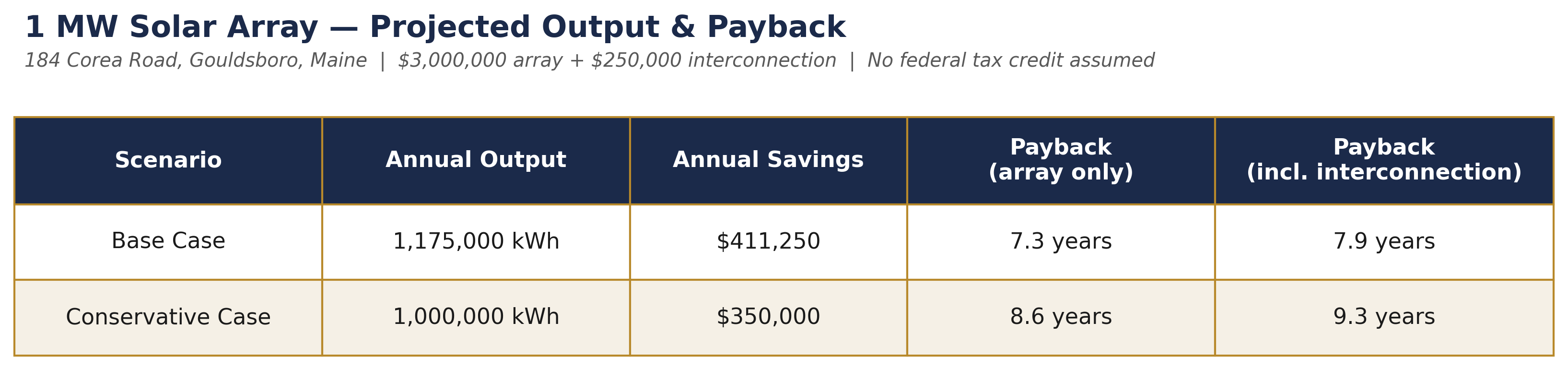
These figures assume no federal tax credit (see below) and are calculated purely against current grid electricity costs, which are rising faster in Maine than in nearly every other state due to ongoing infrastructure and storm-hardening investment.
A Note on Federal Solar Tax Credits
The federal Section 48E commercial solar Investment Tax Credit remains law, but its favorable terms tie to a construction-start deadline of July 4, 2026 — a deadline that has now passed. Because this array has not yet been constructed, the ROI figures above are shown without any federal tax credit assumption. If credit terms change, or a buyer structures the project under a different ownership pathway, the economics could improve; we'd rather show the number that holds up regardless.
Seawater: A Second Advantage
Alongside Power
The site's deeded seawater easements to Prospect Harbor address temperature stability. Intake at approximately 50-foot depth draws water at a materially more stable year-round temperature than surface water or ambient air. Solar and grid power lower the electric bill; stable-temperature seawater lowers the load that bill has to cover.
Smart Load Scheduling
Versant's commercial rate structure keeps per-kWh energy price flat around the clock; the real lever is the demand charge, which runs roughly 7x higher during weekday peak hours than overnight and weekends. An operator can schedule power-hungry equipment such as reverse osmosis around that peak window, or during daylight hours to draw more directly on solar output. A facility without battery storage can optimize for one or the other, not fully both.
Request NDA and Data Room Access
Critical Note
© 2026 Palom Aquaculture LLC. Solar figures are illustrative estimates based on quoted system specs and current rate data. No tax credit is assumed. Buyers should consult a qualified solar developer and tax advisor before making any investment decision based on these projections.